
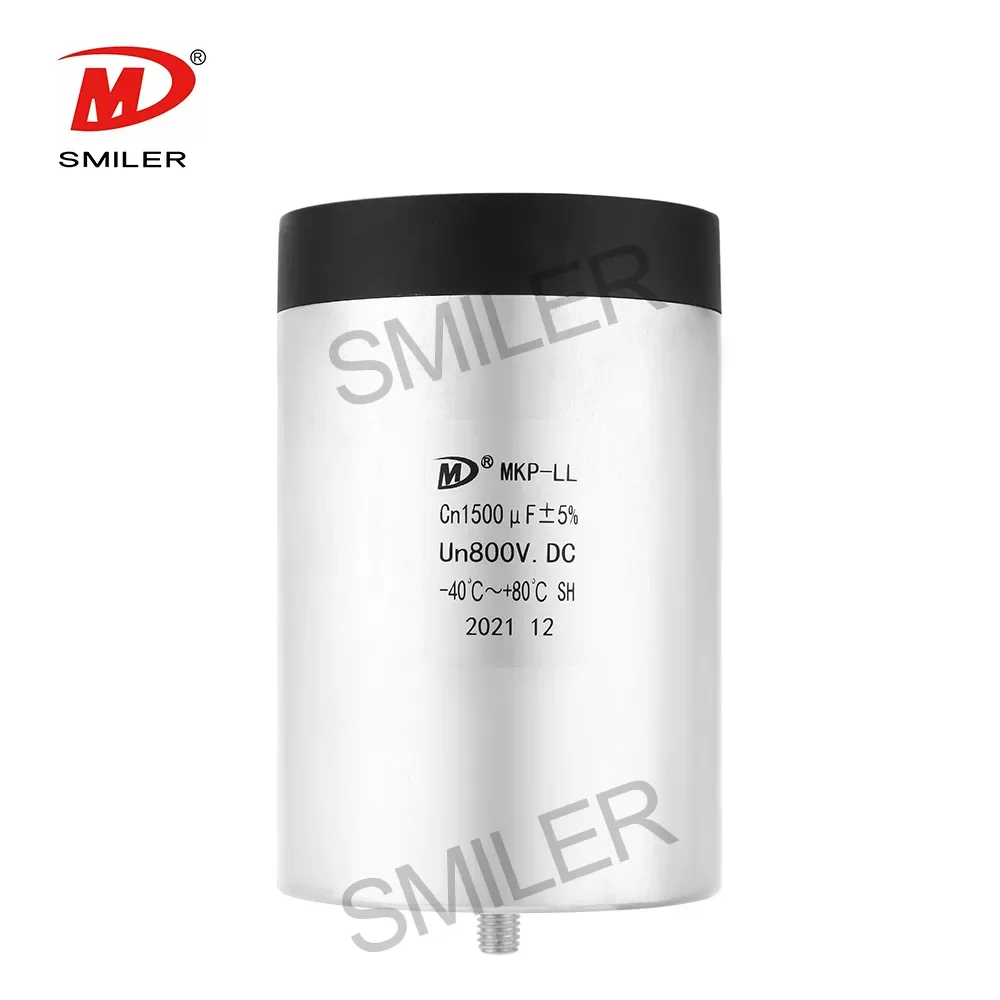
Choosing the right dc link capacitor for your inverter design often comes down to a single mechanical decision: aluminum can or plastic box? The MKP-LL series packs 24–5600 µF into a cylindrical aluminum housing rated for 600–4000 V DC, while the MKP-LM series delivers 1–110 µF in a PCB-mount flame-retardant plastic box rated for 500–1200 V DC. Both use metallized polypropylene film and self-healing dry construction. But they solve very different problems. This article breaks down thermal dissipation, capacitance density, and mechanical integration so you can pick the right package for your bus voltage, ripple current, and assembly line.
Thermal Dissipation: Hot Spot Temperature and Lifetime
Heat is the silent killer of dc link capacitors. Every ripple current cycle generates I²R losses in the metallized film and end connections. How those losses escape the package determines your usable lifetime.
The MKP-LL aluminum can is a thermal workhorse. Its cylindrical aluminum housing acts as a heat spreader, and the M12 bottom mounting bolt or M6/M8 threaded terminals can conduct heat directly into a metal chassis or cold plate. SMILER rates the MKP-LL for 100,000 hours at 70°C hot-spot temperature. That's a long service life for high-power string inverters and wind converters where the capacitor sits near the IGBT modules.
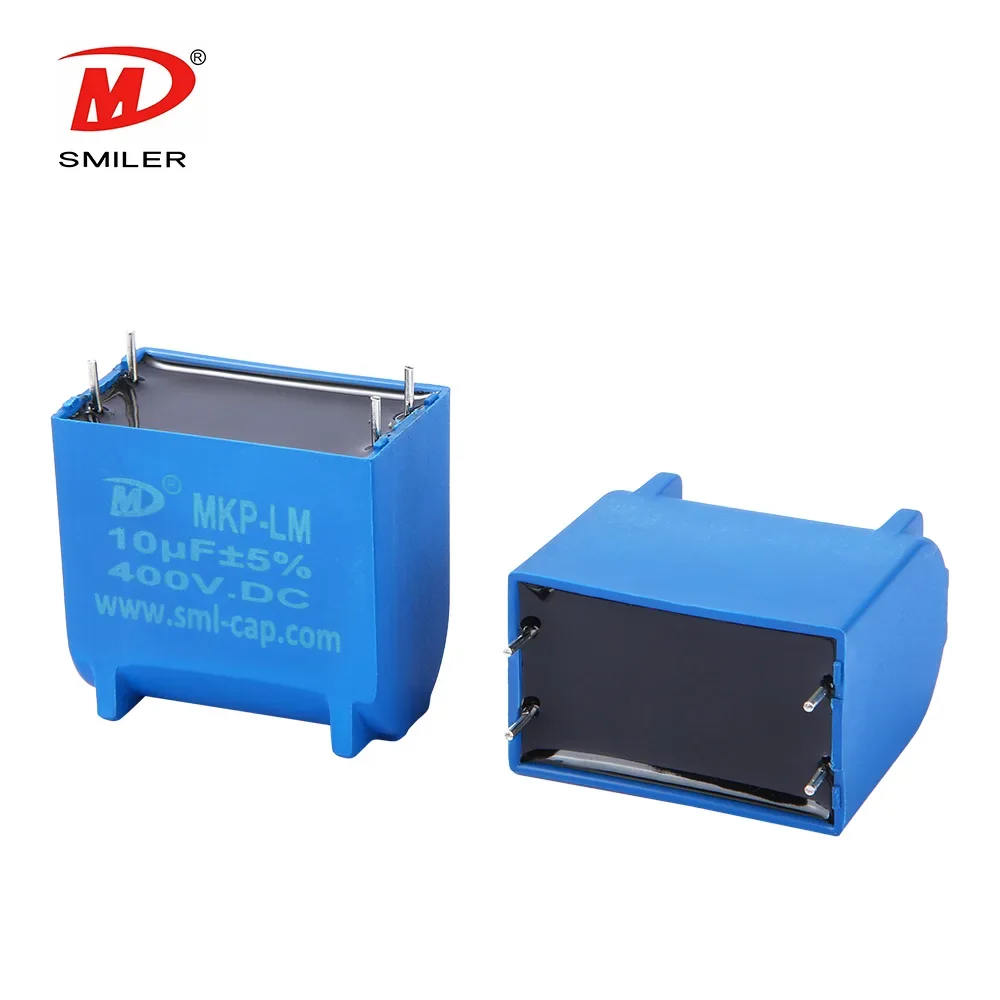
The MKP-LM plastic box takes a different path. Its flame-retardant PPS or epoxy-potted housing (UL94 V-0) is a poorer conductor of heat than aluminum. But the MKP-LM is rated for 50,000 hours at 85°C. That higher allowed hot-spot temperature compensates for the lower thermal conductivity. In a 1100 V DC string inverter with moderate ripple, the plastic box can run hotter without derating. The THB-Type variant adds a PPS high-temperature shell for 85°C/85% RH biased humidity testing (1000 h, |ΔC/C| ≤ 10%), which matters for outdoor solar installations.
Say a 100 kW string inverter runs 60 A RMS ripple at 8 kHz. The MKP-LL's aluminum can might dissipate that heat with a 25°C rise over ambient. The MKP-LM in the same electrical role could see a 40°C rise. But because the MKP-LM tolerates 85°C hot spot versus 70°C for the MKP-LL, both can survive the same ambient. The difference is margin. If your enclosure runs hot or airflow is poor, the aluminum can gives you more thermal headroom per unit of ripple current.
Capacitance Density: Microfarads per Cubic Centimeter
Capacitance density is where the aluminum can dominates. The MKP-LL reaches 5600 µF at voltages up to 4000 V DC. That's because the cylindrical winding geometry packs more film area into a given volume, and the aluminum can withstands higher internal pressure and voltage stress.
The MKP-LM tops out at 110 µF at 1200 V DC. Its plastic box is optimized for lower bus voltages and smaller capacitance values. For a 400 V DC or 800 V DC bus in an EV DC-DC converter or a compact industrial power supply, 110 µF is often plenty. The plastic box wins on board-level integration, not raw microfarads.
Consider a 1500 V DC central inverter that needs 2000 µF of dc link capacitance. You'd need roughly 20 MKP-LM units at 100 µF each, or a single MKP-LL can at 2000 µF. The aluminum can saves board space and reduces the number of solder joints and busbar connections. For high-voltage, high-capacitance designs, the MKP-LL is the clear density leader.
But density isn't everything. If your design needs 50 µF at 800 V DC on a PCB, the MKP-LM is a better fit. It solders directly to the board with 2, 4, or 6 pins, eliminating the need for busbar hardware and mounting brackets. The effective density on the PCB can be higher because you're not wasting space on terminal blocks and clearance distances.
Mechanical Integration: Terminals, Mounting, and Assembly
Mechanical integration often decides the capacitor before electrical specs do. The MKP-LL uses M6 or M8 threaded terminals for busbar connections, plus an M12 bottom mounting bolt. That's a bolted assembly. You'll need a torque wrench (5 N·m for M6, 6 N·m for M8), busbar fabrication, and a chassis mounting point. It's robust and serviceable, but it adds assembly steps and hardware cost.
The MKP-LM is a PCB-mount component. Its 2, 4, or 6 pins solder directly into through-holes. No busbar, no torque spec, no mounting bracket. For high-volume production, that's a massive advantage. Wave soldering or selective soldering handles the connection in seconds. The plastic box also provides electrical insulation, so you don't need extra clearance for the can body.
Here's a practical comparison table to summarize the key differences:
| Parameter | MKP-LL (Aluminum Can) | MKP-LM (Plastic Box) |
|---|---|---|
| Voltage range | 600–4000 V DC | 500–1200 V DC |
| Capacitance range | 24–5600 µF | 1–110 µF |
| Terminals | M6/M8 threaded, M12 bottom bolt | 2/4/6-pin PCB solder |
| Lifetime rating | 100,000 h @ 70°C hot spot | 50,000 h @ 85°C hot spot |
| Housing material | Aluminum can, dry self-healing | Flame-retardant plastic (UL94 V-0), epoxy potted |
| Thermal path | Can body to chassis/cold plate | Pins to PCB copper, convection |
| Typical application | Central PV inverters, wind converters, EV fast chargers | String inverters, onboard DC-DC, industrial power supplies |
| Standard | GB/T 17702 (IEC 61071) | GB/T 17702-2021 (IEC 61071:2007); IEC 60068 |
For a 30 kW string inverter with a 1100 V DC bus, the MKP-LM THB-Type is a natural fit. It solders to the PCB, handles 50 µF at 1100 V DC, and survives damp heat. For a 500 kW central inverter at 1500 V DC, the MKP-LL with M8 terminals and a cold-plate mount is the right call. The bolted connection handles the high ripple current and the aluminum can spreads heat into the chassis.
Ripple Current and ESR: What the Datasheet Doesn't Tell You
Ripple current rating is often the binding constraint. The MKP-LL's low ESR and high ripple current tolerance come from its thick metallized film and large end connections. The M6/M8 terminals provide a low-inductance path to the busbar. For high-frequency switching (8–20 kHz), the aluminum can's internal geometry keeps ESL low enough for most IGBT modules.
The MKP-LM's 2/4/6-pin configuration has higher ESL than a bolted busbar, but it's still suitable for switching frequencies up to 20 kHz in compact designs. The plastic box's epoxy potting protects the film element from moisture and mechanical vibration, which matters in automotive DC-DC converters and outdoor string inverters.
Don't assume the plastic box is always lower ripple. At 85°C hot spot, the MKP-LM's 50,000-hour rating allows a higher temperature rise, which can translate to competitive ripple current for its size. The key is to calculate hot-spot temperature from your actual ripple spectrum, not just the 100 Hz or 120 Hz value. Use the capacitor's thermal resistance and your ambient temperature to find the real margin.
When to Choose Which: A Decision Framework
Choose the MKP-LL aluminum can when your bus voltage exceeds 1200 V DC, your capacitance need is above 200 µF, or your ripple current is high enough that thermal management is critical. Central PV inverters, wind turbine converters, EV fast chargers, and medium-voltage VFDs are classic MKP-LL territory. The bolted terminals and aluminum housing give you a robust, serviceable connection that handles high current and high voltage.
Choose the MKP-LM plastic box when your bus voltage is 1200 V DC or below, your capacitance need is under 110 µF, and you want to eliminate busbar hardware. String inverters, onboard DC-DC converters, industrial power supplies, and compact VFDs benefit from the PCB-mount design. The THB-Type variant with PPS housing is ideal for outdoor or humid environments where 85°C/85% RH testing matters.
You can also mix both in one system. A central inverter might use MKP-LL cans for the main dc link and MKP-LM boxes for local decoupling on gate driver boards. SMILER produces both series in the same factory, so you can source them together. The company's ISO9001:2005 quality system, TUV certificate R 50352497 0002, VDE 40034278, CB CN36735/CN65200, LVD AN 50706408 0001, and RoHS CANEC26003636901 cover the relevant product lines. SGS report 489624232_P+T verifies the manufacturing site.
For more details on the aluminum-can series, visit the MKP-LL aluminum dc link capacitor page. For the plastic-box series, see the MKP-LM PCB dc link capacitor page. You can also browse the full product portfolio to compare other film capacitor families.
Frequently Asked Questions
Can I use an MKP-LM plastic-box capacitor at 1500 V DC?
No. The MKP-LM series is rated for 500–1200 V DC. For 1500 V DC buses, use the MKP-LL aluminum can series, which covers 600–4000 V DC. Exceeding the voltage rating risks dielectric breakdown and premature failure.
Which series has better thermal performance for high-ripple applications?
The MKP-LL aluminum can generally handles higher ripple current because its aluminum housing spreads heat to the chassis or cold plate. But the MKP-LM's 85°C hot-spot rating gives it more thermal headroom at higher ambient temperatures. Calculate your actual hot-spot temperature from the ripple spectrum to decide.
Does SMILER offer custom capacitance values for these series?
Yes. SMILER supports OEM/ODM customization for capacitance, voltage rating, terminal configuration (M6/M8/M12 for MKP-LL; 2/4/6 pins for MKP-LM), and PPS high-humidity housings. The R&D team holds 20 patents and can provide samples in as fast as 5 days.
Related Capacitor Series
Need Datasheets or Custom OEM Film Capacitors?
Send your capacitance, voltage rating, and mechanical drawing. Our 9-member engineering team replies within 24 hours with 5-day prototyping availability.